
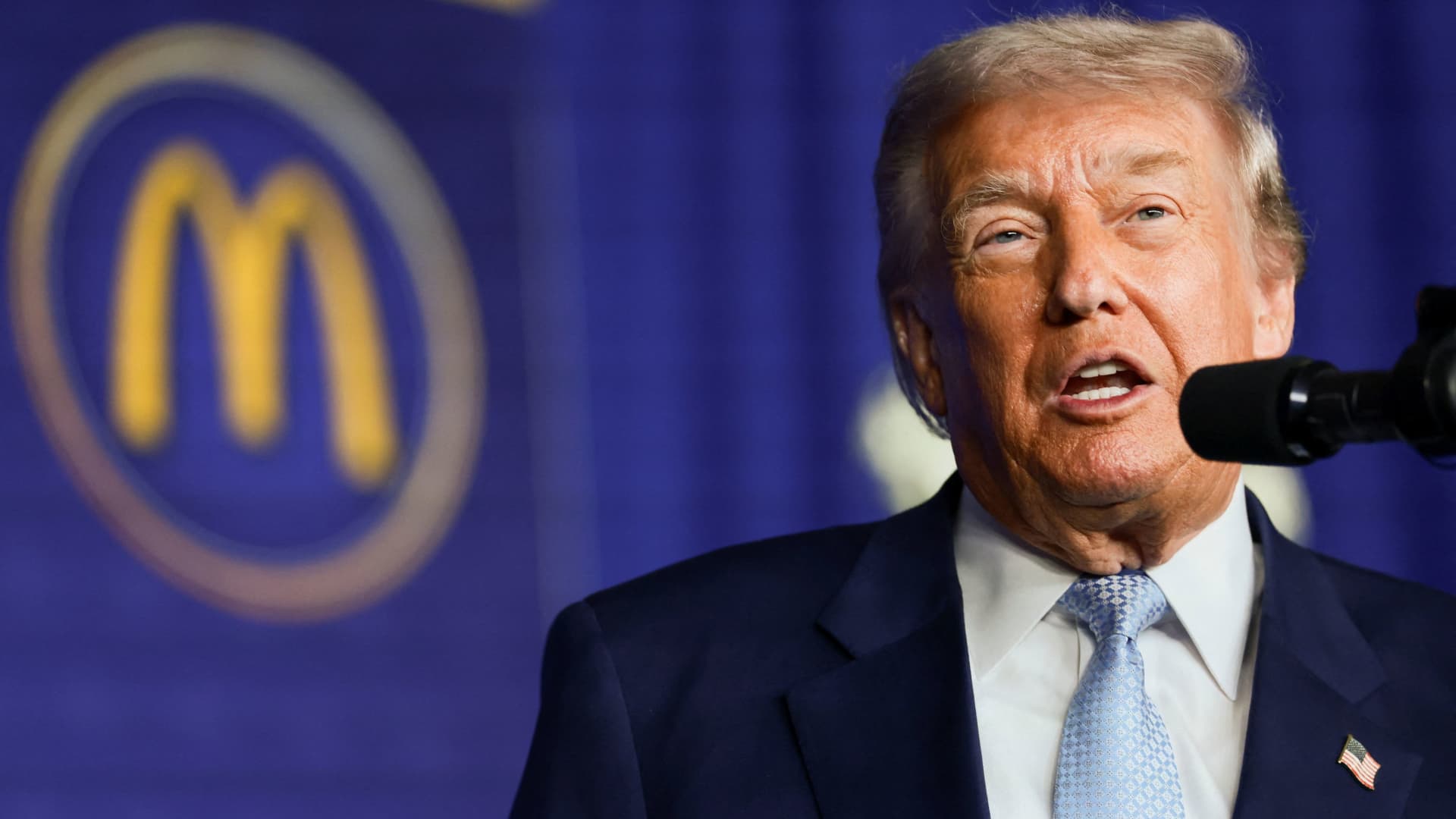

U.S. President Donald Trump delivers remarks at the McDonald’s Impact Summit at the Westin Hotel in Washington, D.C., U.S., Nov. 17, 2025.
Evelyn Hockstein | Reuters
President Donald Trump on Monday said that California Gov. Gavin Newsom is “laying siege on the minimum wage.”
Trump’s comments at the McDonald’s Impact Summit likely referred to California’s higher hourly pay floor for fast-food workers, which took effect a year and a half ago. However, data so far indicate the policy hasn’t been the danger Trump described.
Research shows that the state’s fast-food worker turnover is down. Widespread closures haven’t occurred, and restaurant chains are still opening locations in California.
To be sure, the increased wages have put more pressure on restaurant chains and operators at a time when other costs are climbing and diners are eating out less frequently. Plus, consumers are paying more for their burgers, chicken tenders and fries as a result of the new pay floor.
But after a protracted fight over whether higher pay for workers would harm restaurants, critics’ worst fears have not come to pass.
Fast-food workers in California at chains with more than 60 national locations started earning $20 an hour in April 2024, 25% more than the state’s broader minimum wage of $16 an hour. The sectoral pay floor is part of larger law passed in California that also establishes a council that will recommend proposed industry standards to state agencies and carries the authority to raise the hourly minimum wage annually.
Fast-food workers’ big break only came after a compromise between the restaurant industry and unions that ended months of fighting between the two parties. The Service Employees International Union championed the legislation, saying it would improve workers’ lives and help with industry turnover. Quick-service restaurants argued that they were being unfairly targeted and the wage hike would burden their businesses.
“I firmly believe that everyone should be entitled to a fair wage. The issue that I and my colleagues in this industry have is that we, as an industry, were targeted,” said Kerri Harper-Howie, who runs WEH Organization and its 25 McDonald’s locations in Los Angeles County with her sister, Nicole Harper-Rawlins.. “If someone works at Macy’s and they’re making minimum wage, or they work at CVS … They also should deserve that increase in wages.”
California hasn’t supported a wider minimum-wage increase. Last November, just months after the fast-food pay floor went into effect, voters in the state struck down a ballot measure that would have raised the statewide minimum wage to $18 an hour. It reportedly was the first time in nearly three decades that voters shot down a statewide minimum wage hike on any state ballot.
For now, other states have yet to follow California’s lead, as the nation monitors the effects of the law and the restaurant industry continues to lobby against it.
A scramble for franchisees
A McDonald’s worker prepares…
Read More: Trump criticizes California $20 fast food minimum wage
