

Cameron Pappas, owner of Norton’s Florist
Norton’s
For Cameron Pappas, owner of Norton’s Florist in Birmingham, Alabama, the artificial intelligence boom is a world away.
While companies like Nvidia, Alphabet and Broadcom are lifting the stock market to fresh highs and bolstering GDP, Pappas is experiencing what’s happening in the real economy, one that’s far removed from Wall Street and Silicon Valley.
Small businesses like Norton’s, and companies of all sizes in retail, construction and hospitality, are struggling from higher costs brought by the Trump administration’s sweeping tariffs, and as downbeat consumers reduce their spending.
“We’ve just got an eagle eye on all of our costs,” Pappas, 36, told CNBC in an interview.
Norton’s generated $4 million in revenue last year, selling flowers, plants and gifts to locals. To avoid raising prices, which could cause customers to flee, Pappas has been forced to get creative, reworking some of his designs.
“If a bouquet has 25 stems in it, if you reduce that by three to four stems, then you’re able to keep the price the same,” Pappas said. “It’s really forced us to focus on that and to make sure that we’re pricing things the best that we possibly can.”
Pappas’ story and many like it are being masked in the macro data by the power of AI. In the first half of the year, AI-related capital expenditures contributed to 1.1% of GDP growth, according to a September report from JPMorgan Chase. That spending outpaced the U.S. consumer “as an engine of expansion,” the report said.
Total U.S. GDP increased at an annual rate of 3.8% during the second quarter of 2025 after falling 0.5% in the first quarter, the Commerce Department said.
U.S. manufacturing spending has contracted for seven straight months, according to the Institute for Supply Management. And construction spending has been flat to down, due to high interest rates and rising costs. Cushman & Wakefield said in a report this month that total project costs for construction in the fourth quarter will be up 4.6% from a year earlier because of tariffs on building materials.
The stock market shows a similar disconnect between AI and everybody else.
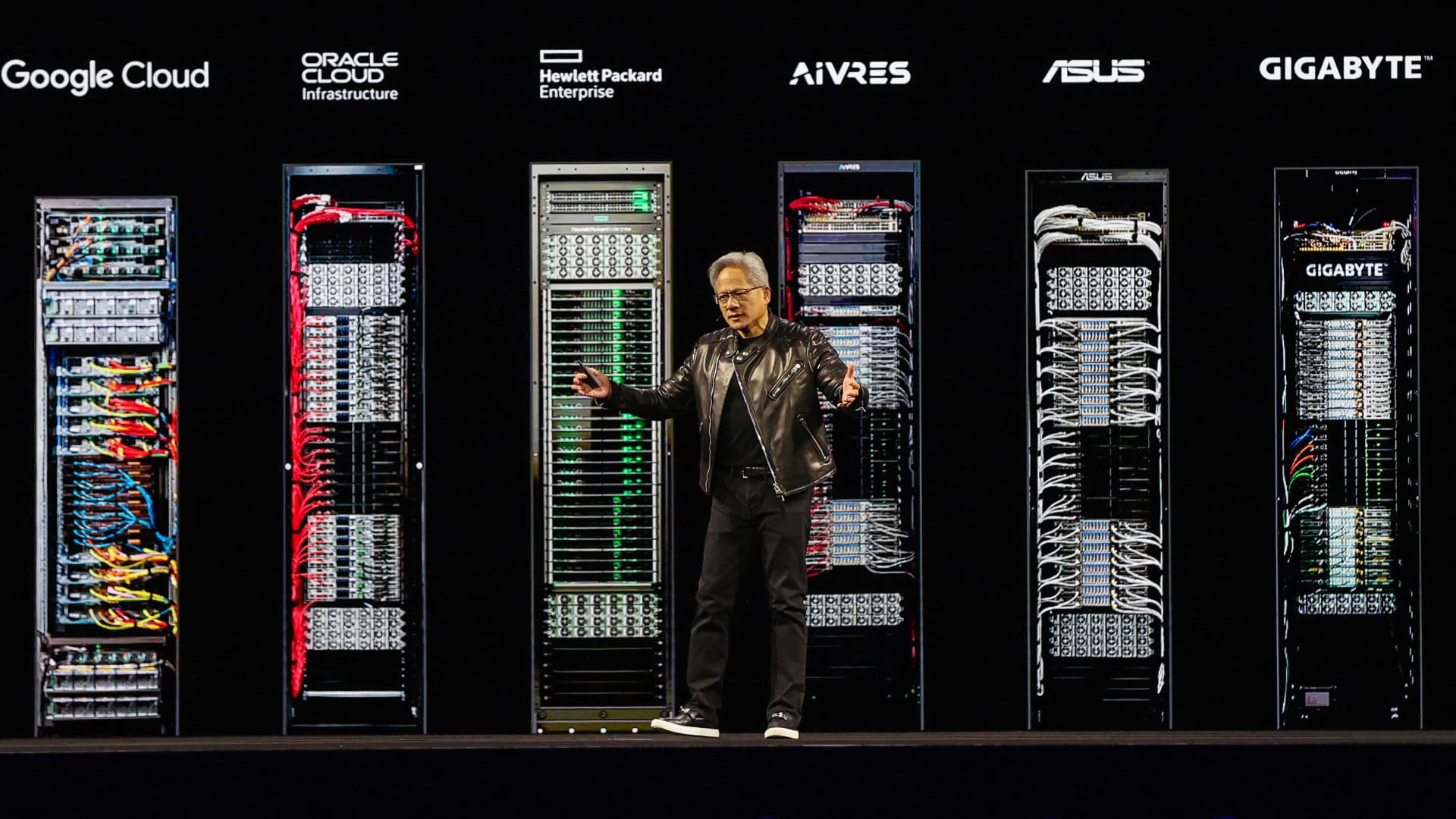
Nvidia CEO Jensen Huang delivers the keynote for the Nvidia GPU Technology Conference (GTC) at the SAP Center in San Jose, California, U.S. March 18, 2025.
Brittany Hosea-Small | Reuters
Eight tech companies are valued at $1 trillion or more and, to varying degrees, are all tied to AI. Those companies — Nvidia, Microsoft, Apple, Alphabet, Amazon, Meta, Tesla and Broadcom — make up about 37% of the S&P 500. Nvidia, with a $4.5 trillion market cap, accounts for over 7% of the benchmark’s value by itself.
Investors are giddy about the massive investments they’re seeing in AI infrastructure. Broadcom shares are up more than 50% this year after more than doubling in each of the prior two years, while Nvidia and Alphabet have jumped almost 40% in 2025.
That explains why the S&P 500 and Nasdaq are up 15% and 20%,…
Read More: AI spending is boosting the economy, many businesses in survival mode
