
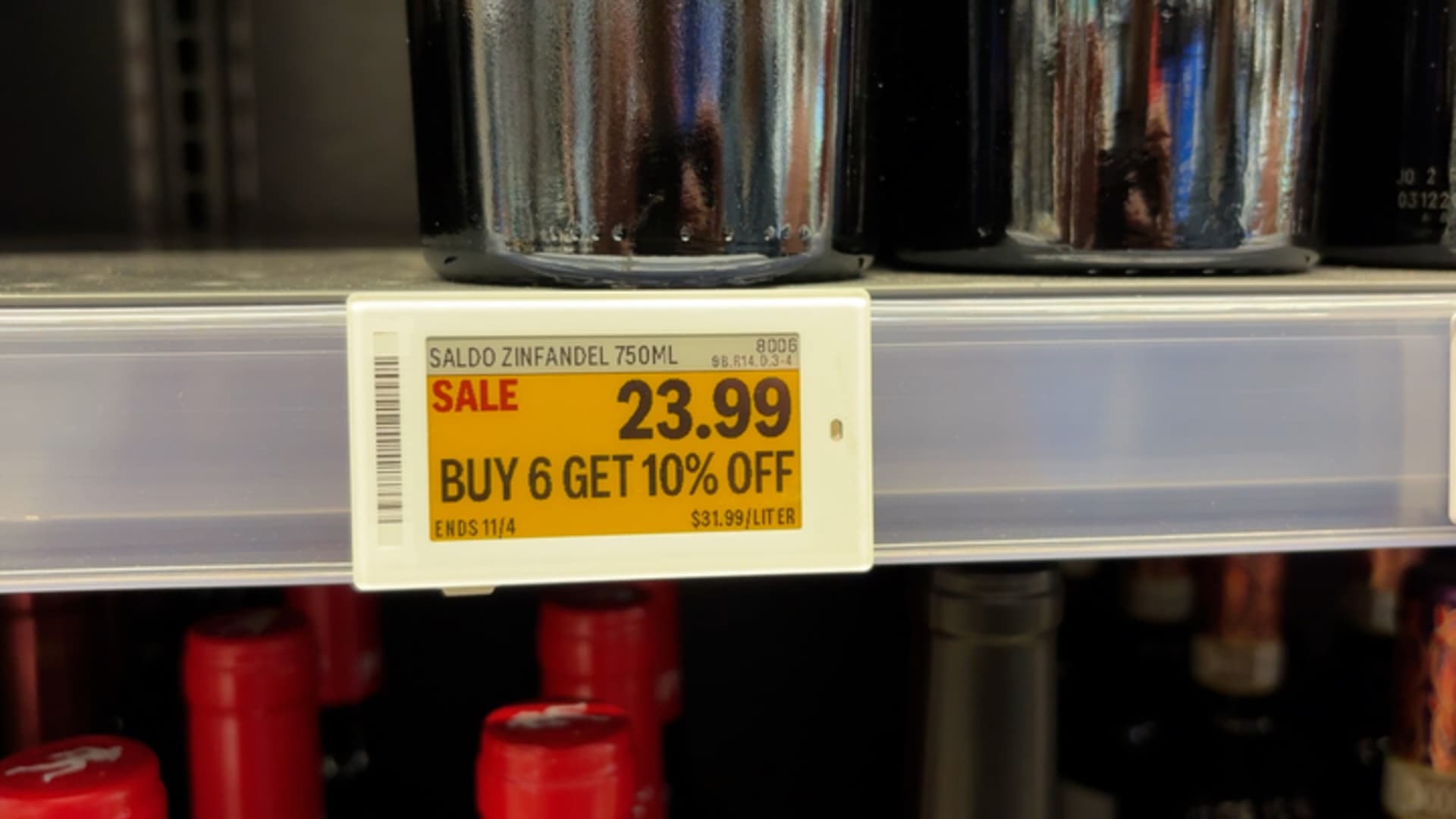

Electronic shelf labels, digital screens that display the price of an item, are replacing traditional paper price tags in grocery stores across America.
The technology can already be found at Whole Foods, Amazon Fresh and Kroger, along with stores in Canada, Europe, Asia and other regions. Electronic shelf labels are expected to become more common: The global market for the products was estimated at $1.85 billion in 2024 and is projected to reach $7.54 billion by 2033, according to Grand View Research.
“It’s definitely an industry that is looking at significant double-digit year-over-year growth for the foreseeable future,” said Cullen Hendrix, senior fellow at the Peterson Institute for International Economics.
Walmart, the largest U.S. retailer, has said it plans to roll out electronic shelf labels to 2,300 stores by 2026. The company said the technology allows employees to update shelf prices using a mobile app, reducing a price change that typically takes an associate two days to a matter of minutes.
“The only impediment to how quickly they can change prices at this point is how long it takes the human in the loop to decide to change the prices,” said Hendrix.
But some lawmakers fear that electronic shelf labels could enable grocery stores to raise prices during periods of high demand.
“Digital price tags may enable Kroger and other grocery chains to transition to ‘dynamic pricing,’ in which the price of basic household goods could surge based on the time of day, the weather, or other transitory events — allowing stores to calibrate price increases to extract maximum profits,” Sen. Elizabeth Warren, D-Mass., and then-Sen. Bob Casey, D-Pa., wrote in an August 2024 letter to Kroger’s then-chairman and CEO Rodney McMullen.
“To be clear, Kroger does not and has never engaged in ‘surge pricing,'” Kroger said in a response letter. [The labels] provide us with operational data to better manage inventory. Those insights allow us to pinpoint opportunities where we can lower prices on items that are perishable, seasonally specific or which otherwise need to move more quickly, including key staples.”
Dynamic pricing reduces food waste by up to 21%, according to a study from the University of California, San Diego’s Rady School of Management that was last revised in December 2023.
Ioannis Stamatopoulos, an associate professor at the University of Texas at Austin and one of the researchers behind a separate study on the topic published in June, said “the facts show there is no surge pricing currently occurring.”
“The basic economics of grocery retail is that they want to acquire customers and retain customers,” Stamatopoulos said. “It’s silly of them to risk upsetting you over gaining a few extra cents on an ice cream when it’s hot outside.”
Amazon said it has “no plans to utilize surge or dynamic pricing.” Amazon-owned Whole Foods declined to comment.
Walmart did not respond to CNBC’s request for comment in time for publication.
Watch the video above to learn…
Read More: Electronic shelf labels are taking over U.S. grocery stores
