
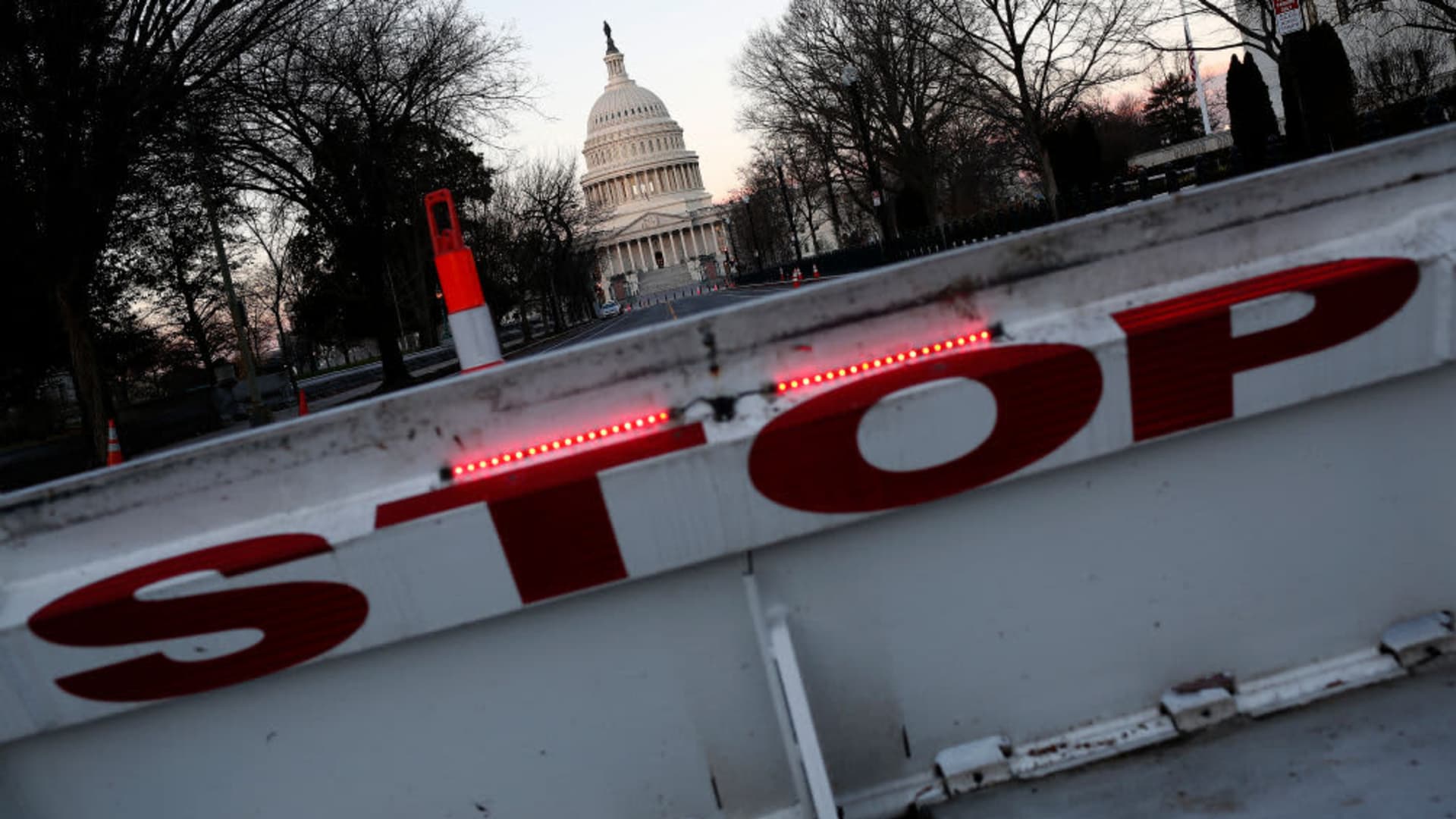

The U.S. Capitol in Washington, DC.
Win Mcnamee | Getty Images News | Getty Images
A looming government shutdown could leave hundreds of thousands of federal employees without a paycheck and put key economic data — including the closely watched Bureau of Labor Statistics jobs report — on ice.
Congress has just four days left to agree on a stopgap bill to keep the federal government fully funded past Tuesday.
But as the clock winds down, Republican and Democratic leaders are digging in their heels against one another, making a shutdown much more likely.
Republicans, who hold narrow majorities in the House and Senate, want to pass a “clean” resolution to temporarily extend funding.
Democrats want the stopgap to include health-care protections, including extensions of enhanced premium tax credits under the Affordable Care Act that are set to expire at the end of the year. The credits reduce the costs of health insurance premiums for a wider swath of Obamacare enrollees.
A funding bill requires 60 votes to be adopted in the Senate, which means it cannot pass if only the 53 Republicans in that chamber vote for it.
President Donald Trump ratcheted up the political brinksmanship this week by canceling a scheduled meeting with Senate Minority Leader Chuck Schumer and House Minority Leader Hakeem Jeffries, the New Yorkers who head the Democratic caucuses in their chambers.
Trump’s Office of Management and Budget raised the human stakes further on Wednesday, when it issued a memo warning federal agencies to prepare for mass firings in the event of a shutdown.
Each side is betting that Americans will blame the other for a shutdown. But regardless of the political dividends, a shutdown will have a major impact on a wide array of services and programs.
And it could lead to unprecedented actions by the Trump administration, which has made shrinking the government a top priority.
What is a government shutdown?
Congress has to pass a series of 12 appropriations bills by Tuesday to finance government entities for the next fiscal year. But it has not passed any of the 12 bills ahead of that deadline.
If it cannot pass a short-term funding measure known as a “continuing resolution,” the government will shut down.
There have been 14 such shutdowns since 1980, according to the Bipartisan Policy Center.
If Congress can only pass some, but not all, of the annual appropriations bills in time, the government will experience a partial shutdown.
That happened in late 2018 — during Trump’s first presidential term — when the government partially shut down for a record five weeks amid disputes about the funding for Trump’s U.S.-Mexico border wall.
How will federal employees be affected?
Non-essential government employees may be furloughed during a shutdown, meaning they are forced to take an unpaid leave of absence.
During the last full government shutdown in 2013, about 850,000 employees were furloughed, according to the Committee for a Responsible Federal Budget.
There are more…
Read More: Federal government shutdown: What will happen
