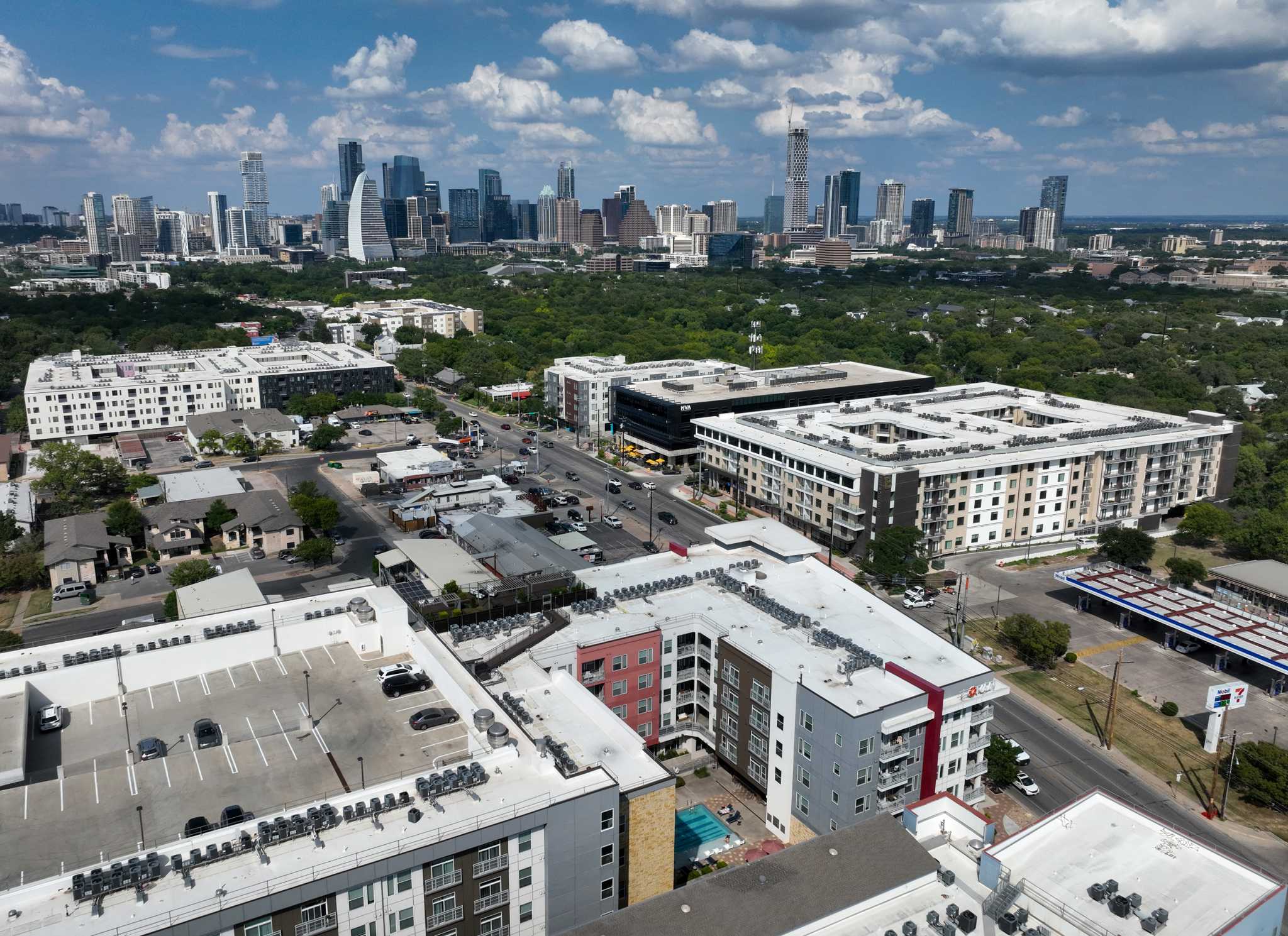


Apartments and condominiums on South Lamar Boulevard. New projects have sprung up along the corridor under new zoning that aims to increase development and add affordable housing. The Bouldin is seen at center right of the photo.
On South Lamar Boulevard, the 78704 artery threaded with coffee shops, fitness studios and taco joints, cranes and leasing banners now share the skyline.
The Bouldin, a new $80 million apartment community at 1401 S. Lamar, just finished construction and is signing its first wave of tenants steps away from Bouldin Creek and Zilker Park.
Article continues below this ad
The 570,000-square-foot, mixed-use property is the latest to deliver in the area but it didn’t spring up in a vacuum.
Early last year, City Council adopted a new combined zoning designation called Density Bonus 90. It’s designed to encourage more affordable homes and neighborhood-serving businesses on major arteries like South Lamar.
FROM 2024: Largest mixed-use project in more than a decade underway on Austin’s South Lamar Boulevard
The zoning allows residential uses on certain commercially zoned sites, relaxes some development standards and allows construction heights up to 90 feet in exchange for inclusion of income-restricted units. Outside the downtown area, which doesn’t have height restrictions, height limits typically range from 40 to 60 feet for commercially zoned properties.
Article continues below this ad
For rental projects, the new zoning designation requires developers to set aside 12% of units for tenants with incomes at or below 60% of the median for area families, or 10% of units at or below 50% of median, for 40 years. For-sale projects require 12% of units to be reserved for those at or below 80% of the median for 99 years, or risk paying a hefty fee.
The city has had a vertical mixed-use zoning program in place since 2006.
Vertical mixed-use zoning increases density by placing ground-floor retail space below residential units in certain high-transit corridors, including Lamar Boulevard. Other mixed-use areas include Burnet Road, East Seventh Street and South Congress Avenue.
In 2022, the city sought to expand existing vertical mixed-use zoning by introducing a second phase of the classification, which added a 30-foot height bonus to the program. A judge struck it down in 2023, though, arguing that city officials ignored a prior court order prohibiting them from approving zoning changes without proper public notice.
Article continues below this ad
Council then created Density Bonus 90, which re-established a path for taller mixed-use housing with clearer affordability requirements. It has seen its share of challenges, too, with Mayor Kirk Watson calling it an “unhappy experience” and announcing a proposed amendment to the program on a message board in May.
“The main thrust of the resolution is…
Read More: Austin zoning changes lead to surge of mixed-used development