
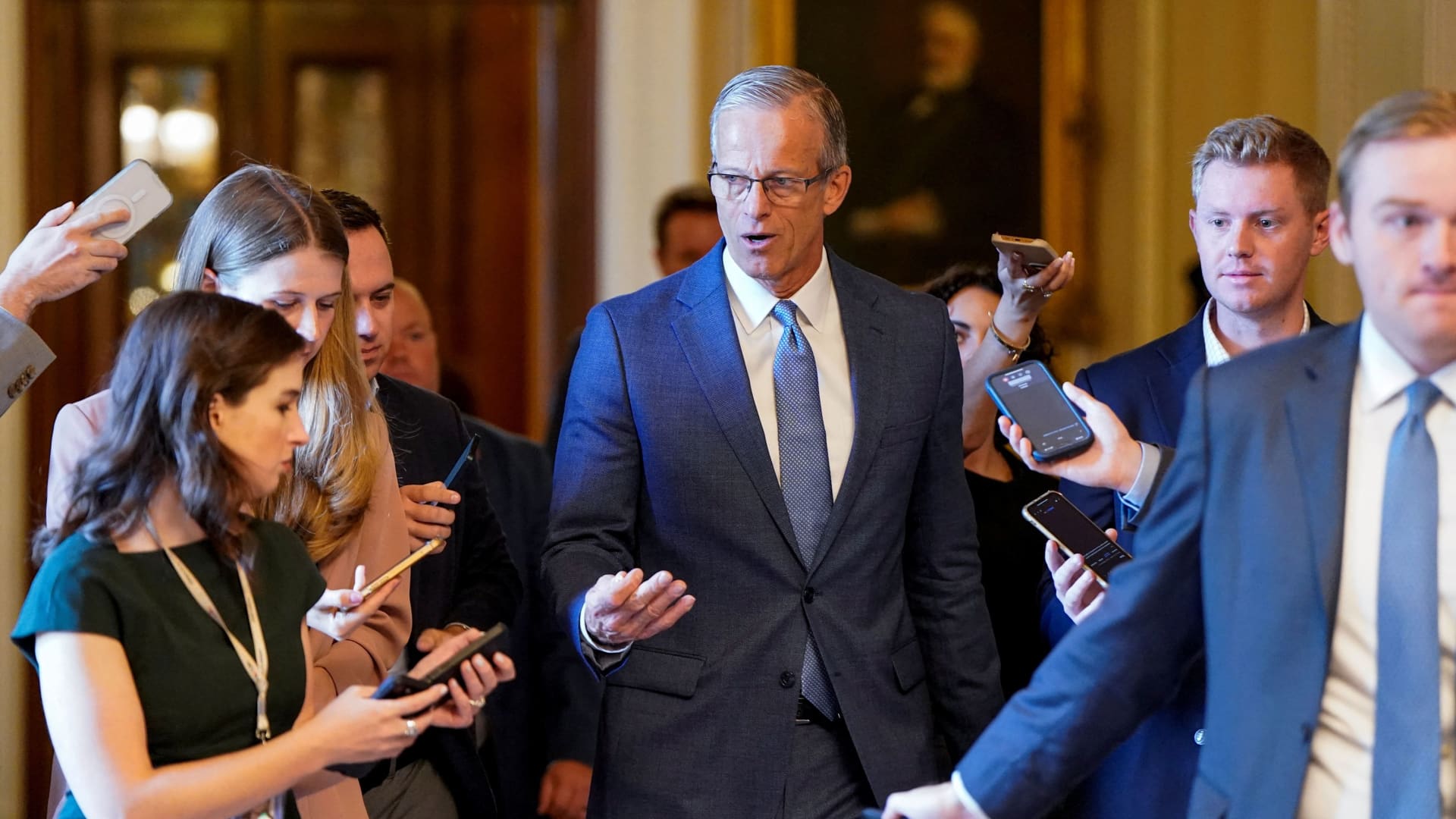

U.S. Senate Majority Leader John Thune (R-SD) walks in Capitol Hill, as Republican lawmakers struggle to pass U.S. President Donald Trump’s sweeping spending and tax bill, in Washington, D.C., U.S., June 30, 2025.
Elizabeth Frantz | Reuters
Senators offered more than a dozen amendments Monday to President Donald Trump’s megabill, following a weekend of tense negotiations on Capitol Hill to try to get the president’s second-term domestic priorities through the upper chamber.
The process, called a “vote-a-rama,” began shortly after 9 a.m. ET and continued well into the night, as senators slogged through individual votes on each amendment. Behind the scenes, Republican leadership worked to maneuver through a series of last-minute changes and shifting alliances.
A final vote on the package cannot occur until the vote-a-rama concludes and every senator has had the opportunity to introduce the amendments he or she wants to. Senate Majority Leader John Thune had predicted the process would finish up sometime late Monday night or early Tuesday morning.

As of 11:30 p.m. ET Monday night, however, Democratic senators showed no signs of wrapping up their long list of amendments and Republicans were still divided among themselves over what the final version should contain.
Throughout the day, Republicans had relied on their narrow majority to defeat repeated attempts by Democrats to alter the bill using amendments.
While the vote tally on the amendments fell largely along party lines, some Democratic-led revisions garnered Republican support and vice-versa.
Sen. Ed Markey, Mass., sought to remove language from the that would, as he put it, “force rural hospitals to limit their services or actually close their doors” due to cuts to Medicaid or Medicare. Republicans Susan Collins of Maine and Lisa Murkowski of Alaska both crossed the aisle and voted with Democrats for Markey’s amendment.
U.S. Senator Susan Collins (R-ME) speaks with Senator Lisa Murkowski (R-AK), as Lori Chavez-DeRemer, U.S. President Trump’s nominee to be secretary of labor testifies before a Senate Health, Education, Labor, and Pensions (HELP) Committee confirmation hearing on Capitol Hill in Washington, D.C., U.S., February 19, 2025.
Kent Nishimura | Reuters
Later in the day, four Democratic senators from battleground states — Sens. Jon Ossoff and Raphael Warnock of Georgia, Catherine Cortez Masto of Nevada and Maggie Hassan of New Hampshire — all voted with Republicans on an amendment that would cut Medicaid funding to states that provide benefits to undocumented immigrants who have been charged with certain crimes.
Senators are allowed to introduce unlimited amendments to a budget bill. Typically, the lion’s share of introduced amendments don’t make it into the final bill. But that’s not always the point.

Amendments are also frequently used to send a political message, or to highlight various senators’ opposition to, or support for, different parts of a big legislative package like…
Read More: Big beautiful bill update: Senate slogs through amendments
