
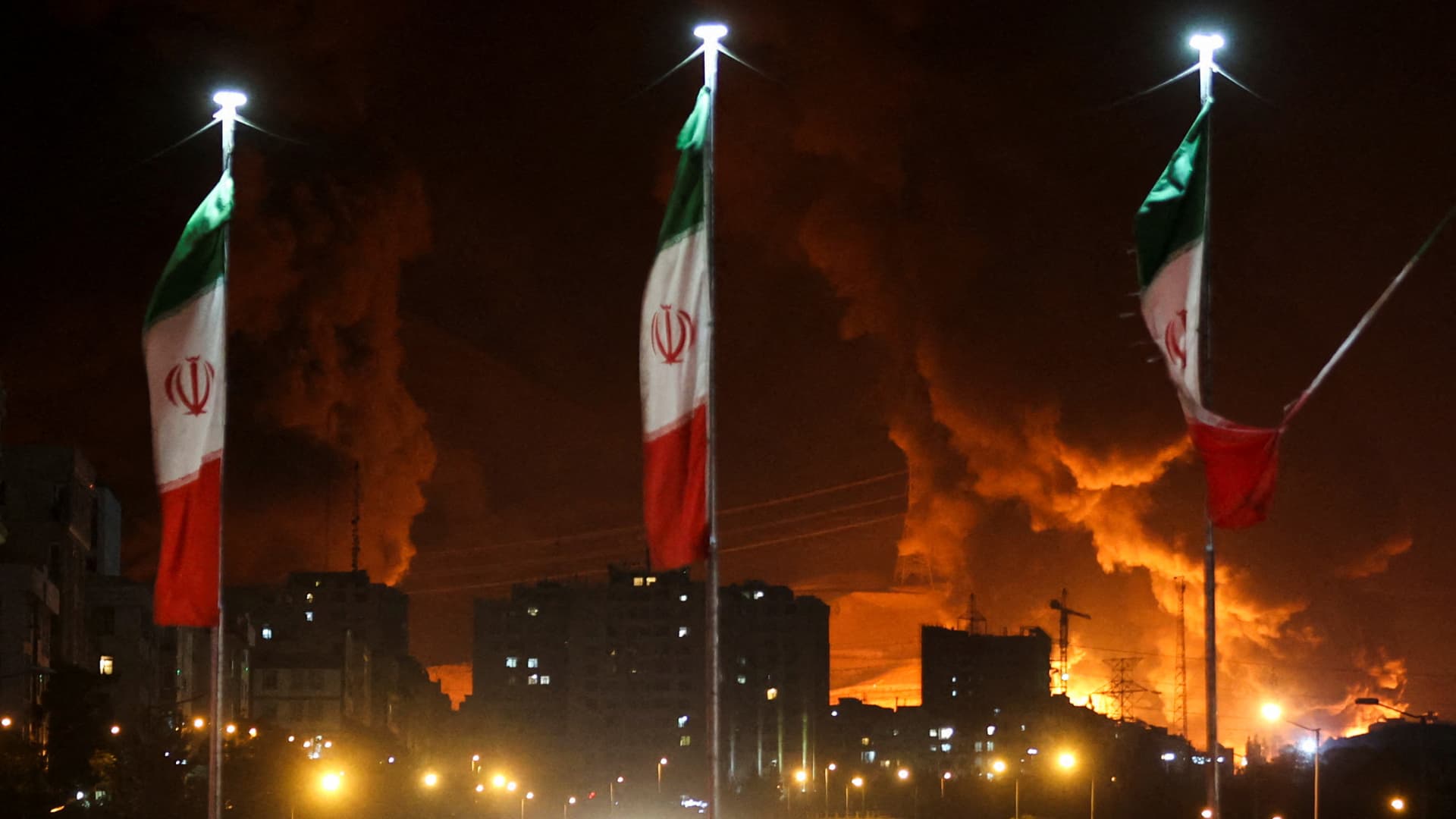


Senior Israeli officials said this week that their military campaign against Iran could trigger the fall of the regime, an event that would have enormous implications for the global oil market.
The oil market has reacted with remarkable restraint as Israel bombed the third-largest crude producer in OPEC for eight straight days, with no clear sign the conflict will end anytime soon.
That could change, however, after the United States unexpectedly joined the conflict on Saturday, attacking three Iranian nuclear sites in Fordo, Natanz and Esfahan.
U.S. crude oil futures and Brent, the global benchmark, start trading on Sunday at 6 p.m. ET. U.S. stock index futures also open at 6 p.m., when Wall Street will have its first opportunity to react to the weekend’s developments.
Oil prices have already climbed about 10% since Israel launched its attack on Iran a week ago, but both U.S. crude oil and the global benchmark Brent have remained below $80 per barrel.
Rising risk
The risk of a supply disruption that triggers a big spike in prices continues to grow the longer the conflict rages on, according to energy analysts.
Trump has previously threatened the life of Iran’s supreme leader Ayatollah Ali Khamenei. For its part, Iran’s leadership is more likely to target regional oil facilities if it feels its very existence is at stake, the analysts said.
Israel’s primary aim is to degrade Iran’s nuclear program, said Scott Modell, CEO of the consulting firm Rapidan Energy Group. But Jerusalem also appears to have a secondary goal of damaging Iran’s security establishment to such an extent that the country’s domestic opposition can rise up against the regime, Modell said.
“They’re not calling it regime change from without, they’re calling it regime change from within,” said Modell, a former CIA officer and Iran expert who served in the Middle East.
Official denial
Prime Minister Benjamin Netanyahu denies that regime change is Israel’s official goal, telling a public broadcaster on Thursday that domestic governance is an internal Iranian decision. The prime minister acknowledged, however, that Khamenei’s regime could fall as a consequence of the conflict.
Defense Minister Israel Katz on Friday ordered Israel’s military to intensify strikes on Iran with a goal to “destabilize the regime” by attacking the “foundations of its power.” Israel reportedly sought to kill Khamenei in the opening days of its campaign, but Trump vetoed the plan.
There are no signs that the regime in Iran is on the verge of collapse, Modell said.
But further political destabilization in Iran “could lead to significantly higher oil prices sustained over extended periods,” said Natasha Kaneva, head of global commodities research at JPMorgan, in a note to clients this week.
There have been eight cases of regime change in major oil-producing countries since 1979, according to JPMorgan. Oil prices spiked 76% on average at their peak in the wake of these changes, before pulling back to stabilize at a…
Read More: How regime change in Iran could affect global oil prices
