
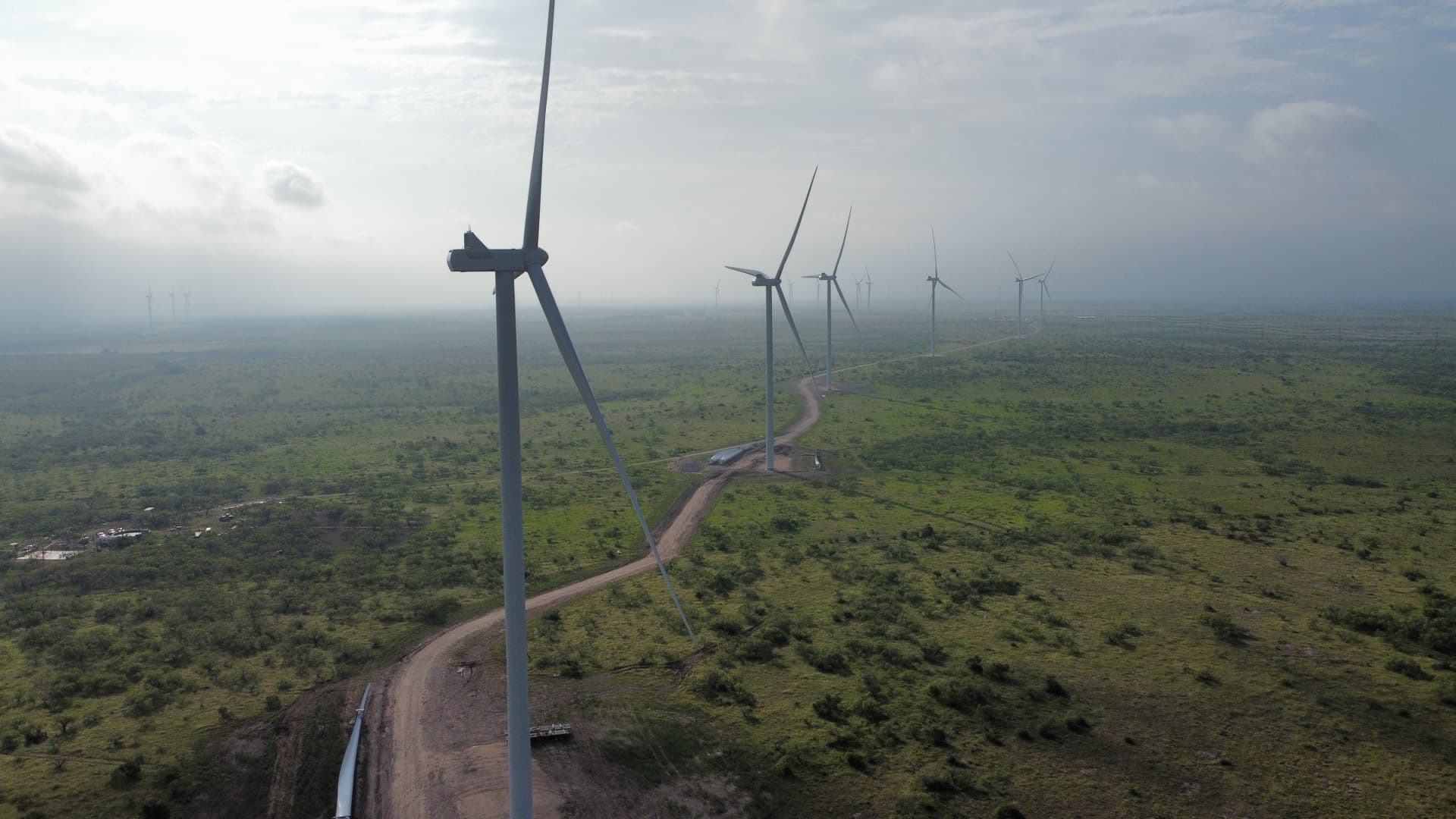

Jeffrey Sanders / 500px | 500px | Getty Images
On Inauguration Day, President Donald Trump issued an executive order indefinitely halting permits for new onshore wind energy projects on federal land, as well as new leases for offshore wind farms in U.S. coastal waters. The action not only fulfilled Trump’s “no new windmills” campaign pledge, but struck yet another blow to the wind industry, which has been hit hard over the past few years by supply chain snags, price increases upending project economics, public opposition and political backlash against federal tax credits, especially those spurring the fledgling offshore wind sector.
Nonetheless, the nation’s well-established onshore wind industry, built out over several decades, is generating nearly 11% of America’s electricity, making it the largest source of renewable energy and at times last year exceeding coal-fired generation. On April 8, the fossil-fuels-friendly Trump administration took measures to bolster coal mining and power plants, but as the infrastructure driving wind energy ages, efforts to “repower” it are creating new business opportunities for the industry’s key players.
This repowering activity has emerged as a bright spot for the wind industry, giving a much-needed boost to market leaders GE Vernova, Vestas and Siemens Gamesa, a subsidiary of Munich-based Siemens Energy. Following several challenging years of lackluster performance — due in particular to setbacks in both onshore and offshore projects — all three companies reported revenue increases in 2024, and both GE Vernova and Siemens stock have moved higher.
GE Vernova, spun off from General Electric a year ago, led overall onshore wind installations in 2024, with 56% of the U.S. market, followed by Denmark’s Vestas (40%) and Siemens Gamesa (4%).

GE Vernova stock performance over the past one-year period.
According to the U.S. Energy Information Administration, installed wind power generating capacity grew from 2.4 gigawatts (GW) in 2000 to 150.1 GW as of April 2024. Although the growth rate for launching new greenfield onshore wind farms has slowed over the last 10 years, the U.S. is still poised to surpass 160 GW of wind capacity in 2025, according to a new report from energy research firm Wood Mackenzie.
There currently are about 1,500 onshore wind farms — on which more than 75,600 turbines are spinning — across 45 states, led by Texas, Iowa, Oklahoma, Illinois and Kansas. Virtually all of the wind farms are located on private land, and many of the largest ones are owned and operated by major energy companies, including NextEra Energy, RWE Clean Energy, Pattern Energy, Clearway Energy, Xcel Energy and Berkshire Hathaway‘s MidAmerican Energy, which generates 59% of it renewable energy from wind, including 3,500 turbines operating across 38 wind projects in Iowa.
A growing number of the turbines are 20-plus years old and nearing the end of their lifecycle. So increasingly, operators…
Read More: Aging U.S. wind energy infrastructure begins its ‘repowering’ era
