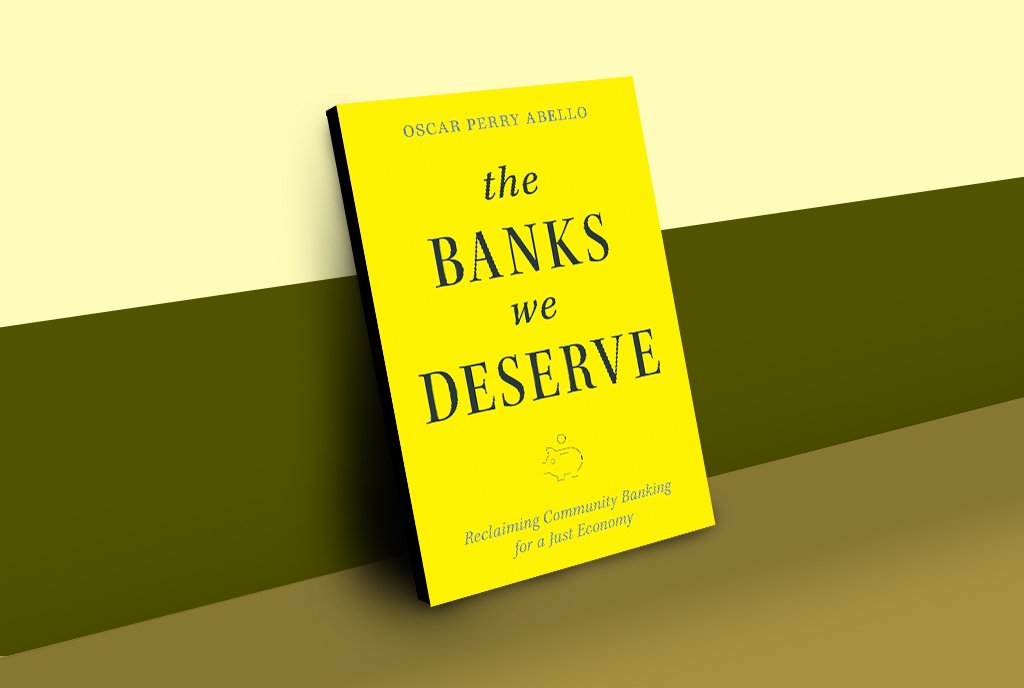


In his latest book, journalist Oscar Perry Abello argues that community banking has a crucial role in addressing urgent social challenges—from developing a racially just economy to preparing for climate change. In this section, Abello addresses the fact that big banks now dominate finance when that wasn’t always to case and how restoring community banking could remedy this issue.
This excerpt is from The Banks We Deserve by Oscar Perry Abello. Copyright © 2025 Oscar Perry Abello. Reproduced by permission of Island Press, Washington, DC.
It’s a lesson worth taking to heart for those who want to confront the big challenges this country and this planet face today, challenges that require action at every level of government, commerce, and industry, challenges like racial inequity, lack of affordable housing, and climate change. We can’t wait around for giant global megabanks to swoop in and save anyone. Communities need to reclaim the power of banking.
We’ve never done anything big in the United States without little banks.
We’ve never done anything big in the United States without little banks. Although community banks like Ponce [a Bronx-based bank founded in 1960 by a group of Puerto Rican activists and business leaders] have always shared the landscape with larger institutions and other kinds of investors, since the country’s inception community banks have made loans to build, acquire, and maintain most of the houses, apartment buildings, storefronts, smaller office buildings, factories, and warehouses that make up the cities and communities where we live, work, play, or gather for worship and other purposes. Community banks also funded the beloved local businesses that have become pillars of so many communities from big city neighborhoods to small town main streets—and they’re still a major source of small business lending today. Even when it comes to big public infrastructure projects like roads, bridges, public transit systems, water and sewer systems, and power systems, all those projects get financed using municipal bonds, many of which community banks bought on the bond market along with other investors. Community banks were once a much larger collective force in the financial system than it might seem given today’s much different banking landscape, where global mega-banks become more dominant every quarter.
There isn’t a universally agreed-upon definition for a community bank, but generally speaking, it’s a bank that focuses on a concentrated geography, like a city or a metropolitan area, or perhaps a rural county. Community banks are also characterized by their reliance on what banks call “soft information”—their knowledge of local community needs and their relationships with local businesses or local developers—to make lending decisions. Since the 1980s, community banks have fallen both in number and in market share. According to the…
Read More: Why Communities Must Reclaim the Power of Banking – Non Profit News