
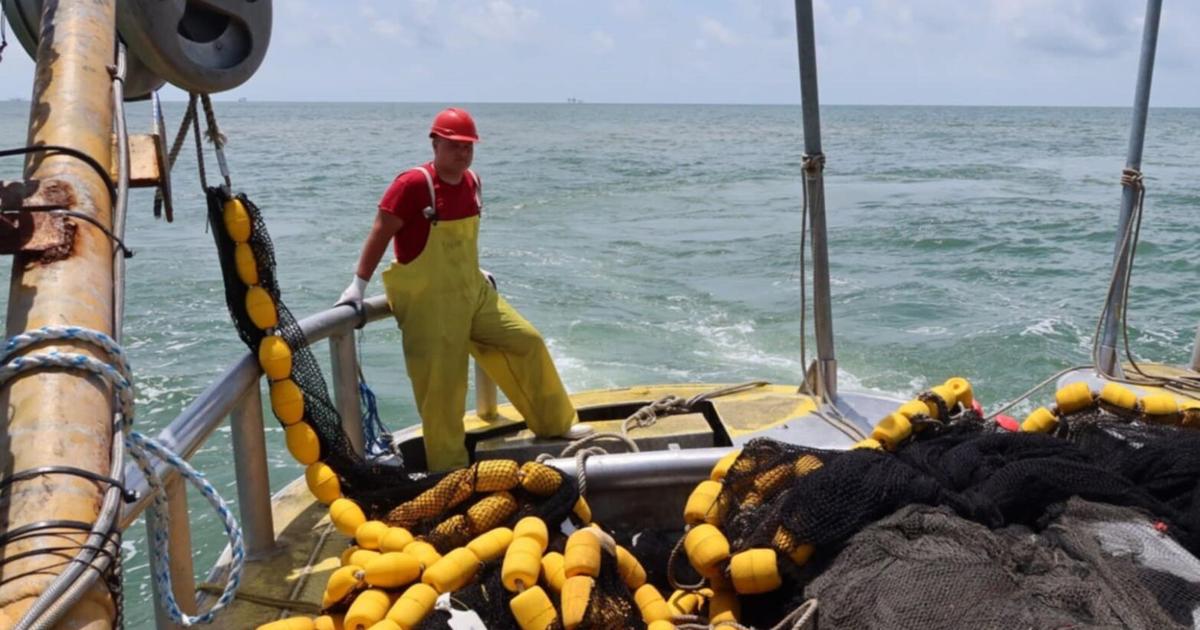

Louisiana’s menhaden industry plays a critical role in the state’s coastal economy, providing jobs and generating millions in economic impact. Together, the industry supports over 2,000 direct and indirect workers, providing good wage jobs in rural coastal communities and contributing $25 million to state and local economies. In a state where commercial fishing is a backbone of our culture, these jobs help keep coastal communities alive.
At the same time, we recognize our responsibility as stewards of the Gulf menhaden resource and have taken proactive steps to ensure the sustainability of our fishery.
While net tears and fish spills are extremely rare, we acknowledge such incidents are unacceptable. That’s why we’ve invested in cutting-edge technology to further reduce occurrences. Over the past four years, the industry has made 65,000 fishing sets, of which only 44 experienced net tears—a minuscule 0.067% incident rate.
Net tears are largely caused by sharks which strike the nets attempting to access the captured fish inside them. The significant increase in the shark population along the Louisiana coast has resulted in an increased incidence of net tears in recent years.
Innovation is Driving Sustainability, Not Additional Regulations
Westbank Fishing, a key operator in the industry, recognizing this growing issue, worked with net manufacturers globally to identify a suitable solution.
Westbank Fishing invested $1.8 million to trial new ultra-high molecular weight polyethylene Spectra/Plateena netting, which is a revolutionary fiber which is ten times stronger than nylon.
Between 2018 and 2023, Westbank Fishing had experienced eight net tears, all of which were when using the industries traditional nylon nets. All but one of these net tears occurred at distances greater than 1 mile from Louisiana’s regulatory fishing line.
Since adopting the Spectra/Plateena nets in May 2023, Westbank Fishing has completed over 15,000 fishing sets without a single net tear. Building on this success, the company is investing another $900,000 in 12 new Spectra/Plateena nets for the 2025 fishing season.
Data shows that industry innovation – not unnecessary spatial restrictions like extended buffer zones – is key to reducing fish spills. Industry-led innovation has proven to be the most effective way to reduce fish spills, demonstrating that targeted technological solutions are more effective than broad, one-size-fits-all spatial restrictions.
Industry-Wide Adoption of Smarter Fishing Technology
After seeing Westbank Fishing’s success,…
Read More: Investing in Innovation: How Louisiana’s Menhaden Industry is Leading in
