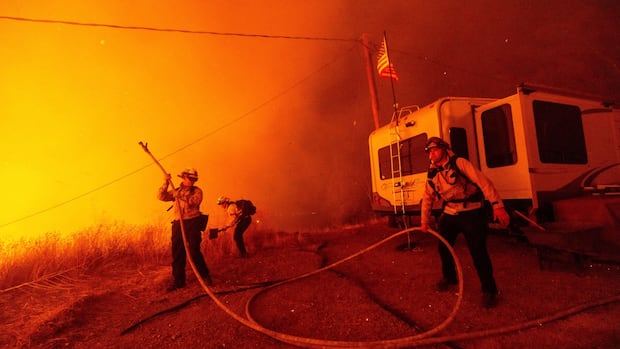

Vicious hurricanes in the southeastern United States. Massive flooding in Ontario and Quebec. Wildfires in Los Angeles.
What these events have in common — besides the fact that climate change has made them more extreme — is that they are pummelling insurance companies.
Preliminary estimates suggest the fires that devastated L.A. — already the costliest wildfires in California history — could put insurers on the hook for between $28 billion and $45 billion US ($40 billion to $65 billion Cdn).
Meanwhile, the Insurance Bureau of Canada recently reported that as a result of events like the Jasper wildfire and flooding in eastern Canada, 2024 set a record for insurance payouts in Canada: $8.55 billion.
This will inevitably lead insurers to raise rates as they try to manage the broader risk. But as premiums rise and some regions become uninsurable, it could have a cascading effect that could lead to a financial crisis, says Gary Yohe, Huffington Foundation professor emeritus of economics and environment at Wesleyan University in Connecticut.
“What’s happening now is that the really, really dark [climate events] are just catastrophic and all in one place, happening at the same time,” said Yohe.
In terms of insurance, he said, “it creates a societal problem, not just an individual problem.”

As Southern California gets some much-needed rain, a new analysis suggests the conditions that led to January’s wildfires were 35 per cent more likely because of human-fuelled climate change. And the more likely those fires become, the more expensive insurance will get for everyone.
The L.A. fires are a good illustration of this. The flames that swept through the Pacific Palisades and Altadena areas burned about 15,000 hectares, killing 29 people and destroying an estimated 16,000 homes.
As Yohe points out, many of the properties will no longer be worth as much as the principal on the homeowner’s mortgage. Some people will walk away from their mortgage and stop repaying the bank.
But it doesn’t end there. A lot of that debt is packaged and sold to investors.
“That gets spread around. That doesn’t just happen in the local California banks,” said Yohe. “They’re part of national chains. Big banks make bundles of derivatives and they sell them to banks all over the world.”
The financial impact of the L.A. wildfires seems contained so far. But Yohe argues a similar weather disaster could very quickly lead to a situation that looks like the 2007/2008 subprime mortgage crisis, which led to a global recession and the loss of millions of jobs and businesses.
Evidence of climate-related mortgage defaults
Not a lot of people have entertained this idea, but as an economist, Yohe has been thinking about the larger impacts of climate change for a while.
Back in 1982, he participated in a preliminary study by the National…
Read More: Climate disasters lead to billions in insurance losses. Could they trigger