
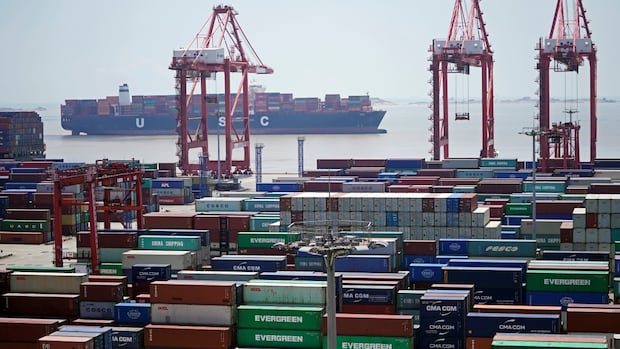

China on Tuesday slapped tariffs on U.S. imports in a swift response to new U.S. duties on Chinese goods, renewing a trade war between the world’s top two economies even as President Donald Trump offered reprieves to Canada and Mexico.
Additional 10 per cent tariff across all Chinese imports into the U.S. came into effect at 12.01 ET after Trump repeatedly warned Beijing it was not doing enough to halt the flow of illicit drugs into the United States.
Within minutes, China’s Finance Ministry said it would impose levies of 15 per cent for U.S. coal and LNG (liquefied natural gas) and 10 per cent for crude oil, farm equipment and some autos. The new tariffs on U.S. exports will start on Feb. 10, the ministry said.
China also said it was starting an anti-monopoly investigation into Google, while including both PVH Corp, the holding company for brands including Calvin Klein and Tommy Hilfiger, and U.S. biotechnology company Illumina on its “unreliable entities list.”

Ian Lee, an associate professor at the Sprott School of Business, says Canada is ‘going to lose’ the tariff war, and that U.S. President Donald Trump is using tariffs as a tool to negotiate a new trade agreement. Lee says Canada has to dismantle interprovincial trade barriers and protectionism to increase productivity.
Separately, China’s Commerce Ministry and its Customs Administration said it is imposing export controls on tungsten, tellurium, molybdenum, bismuth and indium to “safeguard national security interests.”
China controls much of the world’s supply of such rare minerals, which are critical for the clean energy transition.
‘Fairly modest’ measures, for now
Capital Economics, a U.K.-based research firm, estimated that China’s additional tariffs would apply to about $20 billion US of annual imports, compared with the $450 billion worth of Chinese goods subject to the Trump tariff.
“The measures are fairly modest, at least relative to U.S. moves, and have been calibrated to send a message to the U.S.,” Julian Evans-Pritchard, the firm’s head of China Economics, said in a note.
But forecaster Oxford downgraded its China economic growth forecast, saying “the trade war is in the early stages” and further tariffs were likely.
During his first term in 2018, Trump initiated a brutal two-year trade war with China over its massive U.S. trade surplus, with tit-for-tat tariffs on hundreds of billions of dollars worth of goods upending global supply chains and damaging the world economy.

Trump warned he might increase tariffs on China further unless Beijing stemmed the flow of fentanyl, a deadly opioid, into the United…
Read More: China hits back with tariffs on U.S. goods after Trump’s levies take effect
