
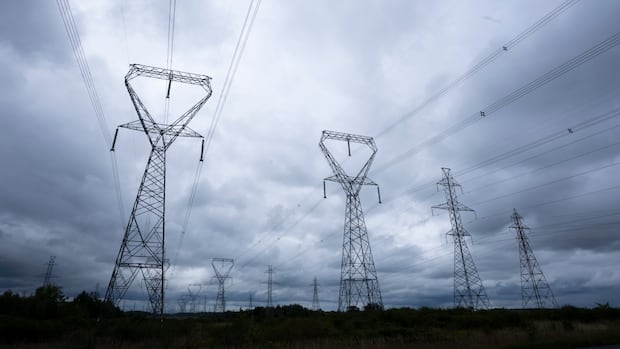

The federal government is backing away from its former goal of achieving net-zero in the national electricity grid by 2035 — but it is promising deeper emissions reductions in the energy sector after 2050.
Ottawa announced the change ahead of the release of the final Clean Electricity Regulations on Wednesday. The move comes after provinces like Alberta, Saskatchewan and Ontario vocally opposed the draft regulations, which they argued were costly and set goals that were impossible to achieve.
The change backs away from a commitment made in the 2021 Liberal election platform.
In an interview with CBC News, Environment and Climate Change Minister Steven Guilbeault acknowledged what the federal government initially put on the table may not have been realistic.
“Some of things that we put on the table were too stringent and from a technical point of view would be very hard to achieve without Canadians incurring a very high cost,” Guilbeault said.
“That’s not something that I want as a Canadian member of Parliament and that’s not something our government wanted either.”
The final regulations provide more time for provinces and territories to comply with the regulations. Non-emitting sources of electricity — hydroelectricity, wind, solar and nuclear — should have no problem falling in line, but natural gas plants will have to meet specific, although less strict, criteria.
For example, emissions from natural gas power plants operating in emergency conditions brought on by extreme weather won’t count under the rules. Also, plants that exceed their emissions limits will be allowed to use greenhouse gas offset credits.
Individual power plants won’t necessarily face emissions limits; an arsenal of units can fall under a broad emissions limit. This could allow electricity providers to run units that pollute more while relying on cleaner units to comply with the regulations.
The regulations also exempt certain industrial entities, like oilsands operations, that generate massive amounts of electricity for onsite use.
The changes mean Canada’s electricity sector will continue to generate more pollution than initially forecast between 2024 and 2050.
Instead of eliminating a cumulative total of 342 million tonnes of carbon dioxide equivalent, the final regulations will cut almost half as much — 193 million tonnes of carbon dioxide equivalent.
Federal officials from Environment and Climate Canada, who were not authorized to speak publicly, said the final regulations achieve even deeper emission reductions after 2050 than initially anticipated.
Officials on a technical call with reporters did not state how deep those post-2050 reductions would be.
In 2022, Canada’s electricity sector was 85 per cent non-emitting thanks mostly to hydroelectric and nuclear sources. Coal-fired electricity generation was phased out in Ontario in 2014 and in Alberta this year.
It’s widely recognized that the world cannot deploy heat pumps and electric buses or electrify heavy…
Read More: Ottawa no longer committed to a net-zero electricity grid by 2035
