

Update: This story has been updated with comments from Intersect Power received after initial publication.
When Teresa Pierce cast her ballot for president on Nov. 5, she had no problem making her decision.
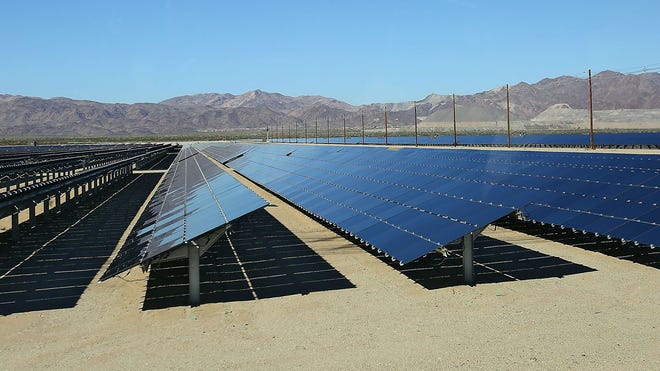
“I definitely voted for Trump so he could stop this insanity of destroying the ecosystem. I know others who did also,” said Pierce, who owns a mobile home in a tiny retirement community in the California desert that has been surrounded on three sides by 18,000 acres of industrial solar projects.
The Bureau of Land Management early this month approved yet another 3,700-acre project that will come within half a mile of their community on the fourth side — and as close as 100 feet to possible future homes. It’s part of the Biden administration’s relentless drive to install renewables across the U.S. to combat climate change.
“From what I’ve read on the internet and watching YouTube videos, Trump is going to cut back a lot on solar,” Pierce said in an email. “The one biggest rip off of all, is all this energy doesn’t even stay here, it goes to LA and San Diego and who knows where else. We are a modest community and it is going to the big mansions along the coast. Until someone has experienced our plight of losing our beautiful desert oasis, they have no idea of how horrible it is.”
So what is the forecast for solar power during President Donald Trump’s second term? Will large-scale projects continue to light up across the sunshine baked Southwest, or will the heated pace of construction slow? Will permitting and transmission delays of a decade or more be eased, especially in California, or will pushback from rural Republicans and a president who denies climate change dim the industry’s prospects?
The answers might surprise you.
During Trump’s first term, commercial solar power amped up as part of his “America First” energy policy, with 36 gigawatts worth of big utility projects built — enough for nearly 7 million homes — and much of that was via leases for large solar farms on public lands in the West. Trump even gave a shout-out to the industry in his debate against Vice President Kamala Harris, saying he’s “a big fan of solar.”

“Trump approved many renewable energy projects here in his first term,” said Patrick Donnelly, a biologist and lobbyist with the Center for Biological Diversity in Nevada, who monitors the environment, wildlife and energy in the arid, sunny Great Basin.
Add rooftop residential, community and commercial solar, and the U.S. solar industry grew by 128% during Trump’s first term, enough to power over 17 million homes. Solar capacity surged even more under Biden, with a whopping 87 gigawatts of utility projects added as of September, and 118 new gigawatts total, according to data compiled by Wood Mackenzie — enough for nearly 38 million homes. And demand continues to grow thanks to several states’ renewables mandates, cheaper costs and the surge of energy-hungry data centers. Meta, Amazon, Google,…
Read More: Trump administration solar energy policy
