
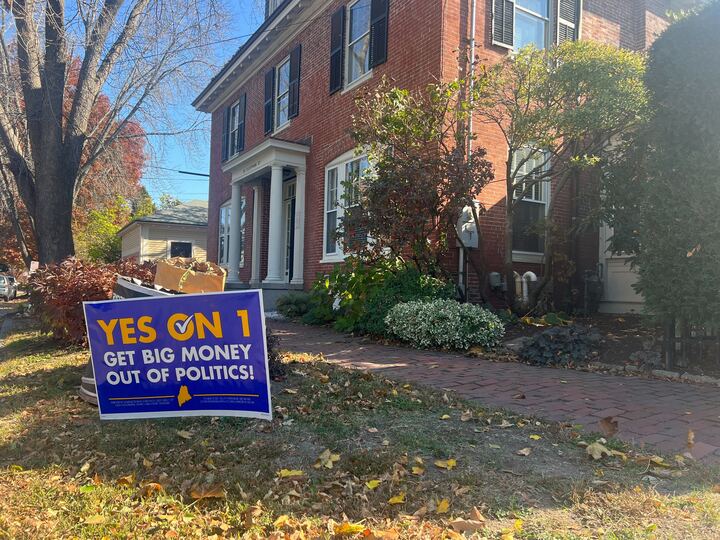

Mainers voted on Tuesday to place limits on donations to political action committees that independently spend money to try to support or defeat candidates — teeing up a path to get the U.S. Supreme Court to reassess some campaign finance regulations.
The citizen referendum, which received 74% of voter support with 62% of votes counted as of 2:20 a.m. Wednesday, asked, “Do you want to set a $5,000 limit for giving to political action committees that spend money independently to support or defeat candidates for office?”
The ultimate goal of those behind the question, however, is to get the high court to rule that PACs should be regulated.
Signature gathering for the referendum first started around the November election last year, as the latest effort from legal scholar Lawrence Lessig to address a core flaw he and other scholars believe a lower court overlooked when establishing super PACs 14 years ago.
Since Buckley v. Valeo in 1976, the Supreme Court has allowed contributions to be regulated when there is a risk of “quid pro quo” corruption, essentially a favor for a favor. In the case of elections, if there is a risk someone could be making a donation to a candidate in exchange for a favor, only then can Congress regulate that contribution. In 2010, the Supreme Court extended this reasoning to corporations and unions in Citizens United v. Federal Election Campaign Act.
Three months later, in SpeechNow.org v. FEC, the U.S. Court of Appeals for the District of Columbia Circuit upheld that contributions to groups making independent expenditures can’t corrupt or create the appearance of corruption. That decision essentially created the “super PAC,” which can receive unlimited contributions but can’t contribute directly to candidates. Other lower federal and state courts followed suit, and the ruling was never reviewed by the Supreme Court.
Lessig previously told Maine Morning Star he thinks there is no chance the Supreme Court will change Citizens United but that the question the Maine referendum raises is not answered in Citizens United — whether contributions to a committee that makes independent expenditures can be limited.
Harvard Law professor emeritus Larry Tribe and Chicago Law professor emeritus Al Alschuler, a Maine resident who submitted the application for the petition, argue that large contributions to PACs inevitably create a risk of quid pro quo corruption, given that donors and candidates have the opportunity to collaborate even if a PAC is independent.
Therefore, Tribe and Alschuler argue, contributions to PACs can be regulated by Congress.
Now that Mainers have voted to approve the referendum, the expectation is that its legality will be challenged almost immediately, presenting an eventual path to the Supreme Court. As for how the Supreme Court will rule, nothing is guaranteed, but Lessig believes the justices will agree with Tribe and Alschuler’s…
Read More: Mainers vote to reform campaign finance, open path for Supreme Court to
