
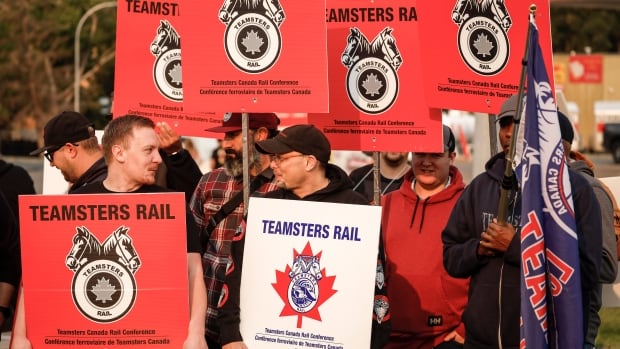

The Teamsters union has served Canadian National Railway (CN) with a 72-hour strike notice, hours after saying it was taking down picket lines and workers were returning to the job.
“Please find this letter as official notice to the company of our intention to withdraw the services of our combined membership of approximately 6,500 members,” reads the notice sent to CN on Friday morning by the Teamsters Canada Rail Conference.
The notice says that the union does not believe any of the ongoing issues between the railway and the Teamsters to be “insurmountable” and that it remains open to negotiating with the company in order to prevent any “further work stoppage.”
The strike notice comes after months of increasingly fraught contract talks between the Teamsters and Canada’s two biggest railways, CN and Canadian Pacific Kansas City (CPKC).
CN issued a statement Friday afternoon saying that while it remains focused on getting its network back up and running, “the Teamsters are focused on returning to the picket line and shutting down the economy, impacting people and jobs across the country.”

The Teamsters union has served Canadian National Railway with a 72-hour strike notice, hours after saying it was taking down picket lines and its workers were returning to the job.
Speaking in Calgary, François Laporte, the president of Teamsters Canada, said the company’s demands would have broken the union’s collective agreement and that its priority is to ensure union members have “decent and reasonable working conditions.”
“We believe in fair and honest bargaining and that’s what we want, we want a fair and honest bargaining with the company,” he said.
Both companies locked out their 9,300 engineers, conductors and yard workers just after midnight Thursday after failing to reach deals with the union by a Thursday deadline. CPKC’s 3,500 workers went on strike at the same time.
The unprecedented work stoppage prompted federal Labour Minister Steven MacKinnon to refer the dispute to the Canada Industrial Relations Board (CIRB) to impose binding arbitration, under Section 107 of the Canada Labour Code.
It is now up to the CIRB to decide how best to settle negotiations and whether that requires binding arbitration.
“It’s not in the powers of the minister, it’s in the powers of the board,” said Gilles LeVasseur a business law professor at the University of Ottawa.
In order for the CIRB to impose binding arbitration, it must justify it as the only way of dealing with the dispute.
The CIRB must also “justify that the economic situation impacts the public to sustain that arbitration requirement,” said LeVasseur.
CPKC said it was prepared to discuss the resumption of service at a meeting with the CIRB, but the union refused and said it intends to make submissions to challenge the…
Read More: Teamsters union serves CN Rail with 72-hour strike notice as CPKC stoppage
