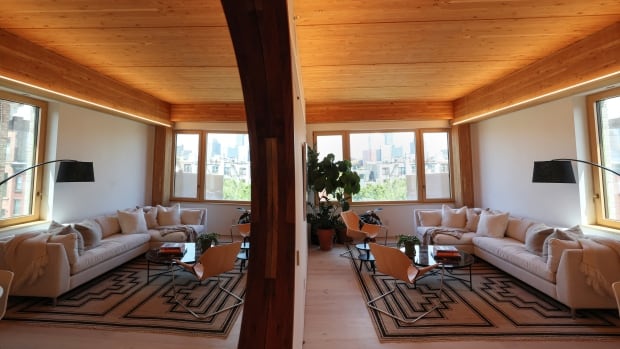

Urban downtowns are sometimes called concrete jungles because the apartments and office buildings that make up skylines from New York to Vancouver are generally made of — what else? — concrete.
But that could change with a push underway to build more tall buildings with another material: mass timber.
Mass timber is an umbrella category of materials made by binding layers of wood together to create larger, stronger elements like panels and beams. Proponents say it’s faster and easier to build with than concrete and steel, and less carbon-intensive to boot.
If concrete and steel are the Coke and Pepsi of highrise construction, mass timber has so far been more of a generic-brand cola. Mass timber made up just one per cent of all building construction materials in North America in 2022, according to an RBC report.
But analysts expect the market to rapidly expand in the years ahead, and all across the country, existing mass-timber plants are being expanded and new ones are in the works, from B.C. and Alberta to Ontario and Nova Scotia.

There’s been an increase in large-scale building projects using mass timber, otherwise known as engineered wood. Experts say the material offers several benefits compared to steel and concrete — including sustainability and speed. Talia Ricci explores whether it could be part of a solution to Toronto’s housing crisis.
“The demand is extremely high for mass timber now,” said Frank Gannon, director of stakeholder engagement with mass timber manufacturer Western Archrib. He spoke with CBC News inside a new, 155,000 sq. ft. facility the company is building north of Edmonton to keep up with its growing orders.
“We are filling capacity slots about 10 months out from today — so yes, the phone’s ringing off the hook.”
The industry is getting a boost from new building codes that allow taller mass-timber buildings, and federal and provincial programs and policies that encourage builders to use more of it.
But so far, the uptake of mass timber has been uneven across the country, as some builders remain reluctant to switch from tried-and-true materials to something new.
And while much of the buzz around mass timber comes from its low carbon profile, some experts disagree about how climate-friendly it really is.
Beams and columns, floors and walls
The two most common types of mass timber are glue-laminated timber, or glulam, and cross-laminated timber, or CLT.
Glulam, which has been around since the early 20th century, is used to make beams and columns. CLT panels are a more recent innovation used for floors, roofs and walls.

Taken together, the two materials can serve as an…
Read More: Is mass timber the next big thing in cheaper, greener construction? More