


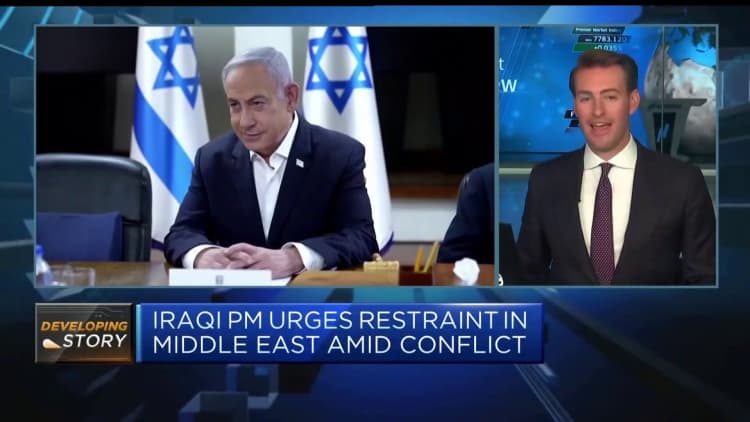
Vowing retribution but urged to show restraint, Israel has yet to agree on its response to an expansive drone and missile strike carried out on its territories by Iran on Saturday.
A Monday meeting of Israel’s five-person war Cabinet, headed by Prime Minister Benjamin Netanyahu, concluded without comment on whether the Jewish state will honor its pledge to “exact a price” from Tehran or concede to calls for a measured response from international leaders.
The prolonged deliberation came after the Israeli military said that Iran on Saturday fired more than 300 drones and missiles at its soil. It claimed that it and international allies eliminated 99% of these attacks as part of its now-dubbed “Iron Shield” operation.
The U.S., U.K., France and Jordan assisted in intercepting these threats. Tehran said its assault was in response to an Israeli strike that killed several top commanders at an Iranian consulate in Damascus, Syria, on April 1 — an offensive for which Israel has yet to claim responsibility.
Iran said the Saturday hostilities have “concluded” its retaliation — and Israel is now left to consider next steps.
The Israeli war Cabinet is set to meet again Tuesday, according to Reuters. The prime minister’s office and Foreign Ministry did not immediately respond to a CNBC request for comment.
Speaking after the Cabinet’s Monday gathering, an Israeli official said that the country’s decision-makers believe it is important for any potential response to closely follow the attack, and that such a gesture would be coordinated with Washington, NBC News reports.
Concerns are mounting that the conflict — rooted in the Oct. 7 terror attack undertaken by Palestinian militant group Hamas and Israel’s retaliatory war campaign in the Gaza Strip — will seep into the broader Middle East region. Since October, Israel has traded fire with a spate of other Iran-supported factions, such as Lebanon’s Hezbollah, Yemeni Houthis and Bashar Assad’s Syrian administration.
Global markets have also been rattled by the hostilities. Oil prices have been bolstered by the potential for disruptions from heavyweight crude producer Iran, and international maritime trade has faced delays and suspensions amid Houthi attacks in the Red Sea.
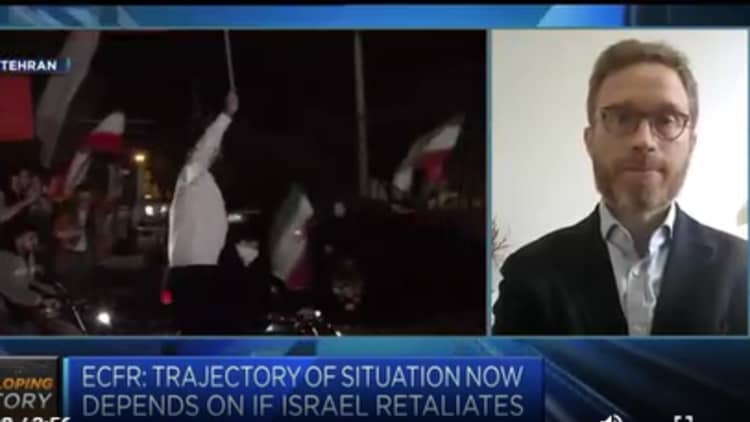
“There are those in the war Cabinet now who will be pushing for a wider campaign in Lebanon against Hezbollah, against Iran itself to take advantage of this moment,” Julien Barnes-Dacey, director of the Middle East and North Africa program at the European Council on Foreign Relations, said Tuesday on CNBC’s “Street Signs Europe.”
‘Mr. Security’
Netanyahu, who has previously battled fraud and corruption charges and civil protests over his proposed judicial reforms, faces domestic pressure to assume a hard line against Iran – and international ones to stand down.
In a Google-translated social media post, Israel’s foreign minister, Israel Katz, said he is mobilizing a “diplomatic offensive” against Iran, noting that he has sent 32 world…
Read More: Israel’s war Cabinet is locked between restraint and revenge
